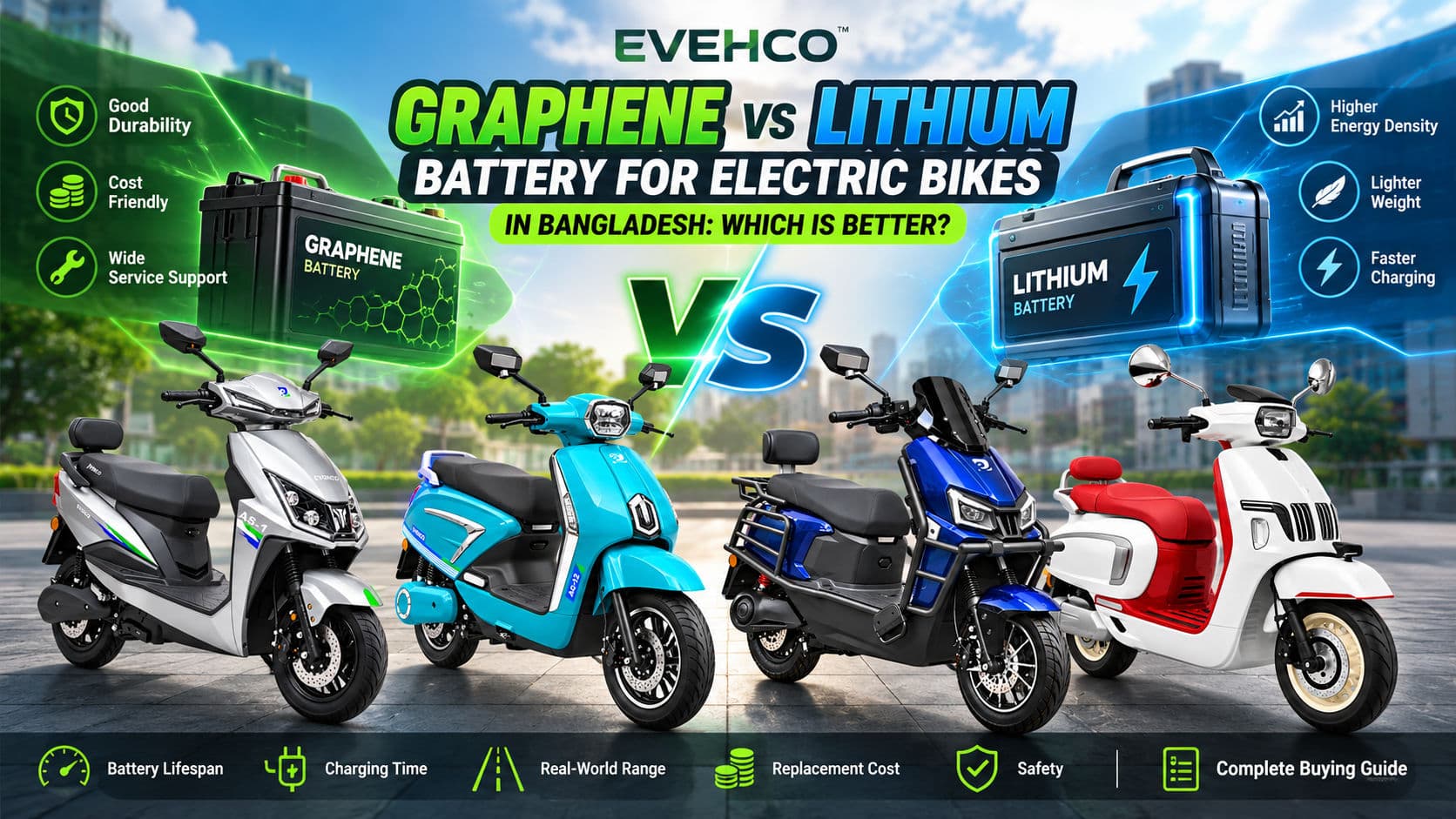
Graphene vs Lithium Battery for Electric Bikes in Bangladesh: Which Is Better?
Quick Answer: Graphene or Lithium Battery for an Electric Bike?
Choosing between a graphene battery and a lithium battery is one of the most important decisions when buying an electric scooter or electric bike in Bangladesh. But the terms are often misunderstood. “Graphene battery” is not one universal battery chemistry. In many electric two-wheeler listings, it refers to a lead-acid battery with graphene or carbon-based enhancements. Lithium-ion, meanwhile, is a family of rechargeable chemistries, including lithium iron phosphate (LFP) and nickel manganese cobalt (NMC).
Short answer: A well-designed lithium-ion pack often offers more stored energy for its weight, while a graphene-enhanced lead-acid option may suit buyers whose priority is initial affordability and an established service arrangement. Actual lifespan, range, charging time and value depend on the specific battery pack, not its marketing label. Before buying, confirm the chemistry, capacity, approved charger, warranty and replacement availability.
This guide explains the technical differences in straightforward terms and shows how to compare EVEHCO electric two-wheelers without inventing battery prices or performance claims.
What Is a Graphene Battery in an Electric Scooter?
Graphene is a form of carbon that can be added to certain battery components to influence conductivity and electrochemical performance. In the electric two-wheeler market, the term “graphene battery” frequently describes a graphene-enhanced lead-acid battery, not a battery made entirely from graphene.
Published research on lead-acid cells has found that certain graphene additives can improve charge acceptance or cycling under specific laboratory conditions. That does not establish a universal lifespan for every commercial graphene-labelled battery.
Always ask the seller whether a product is lead-acid, graphene-enhanced lead-acid or something else. The words “graphene,” “graphite” and “GLA” on an advertisement should not be treated as a complete chemistry specification. You need the manufacturer's documentation for the exact pack.
What Is a Lithium-Ion Battery?
A lithium-ion battery stores energy through reversible movement of lithium ions inside its cells. Lithium-ion packs are popular in electric vehicles partly because of their comparatively high energy density: they can store substantial energy without requiring as much mass as many older battery technologies.
However, “lithium battery” is not a single design. Two common chemistries are:
Lithium Iron Phosphate (LFP)
LFP uses a lithium iron phosphate cathode. It is often selected for applications that prioritise durability and thermal characteristics, although actual safety and lifespan depend on cell quality, electronics, assembly and operating conditions. A pack described as LFP still needs a suitable battery management system (BMS), charger and enclosure.
Nickel Manganese Cobalt (NMC)
NMC is another lithium-ion chemistry used where energy density matters. Its trade-offs differ from LFP, and neither is automatically best without considering the finished pack.
Graphene vs Lithium Battery: Key Differences
Buying factor | Graphene-enhanced lead-acid, where confirmed | Lithium-ion (LFP or NMC) |
|---|---|---|
Battery chemistry | Usually lead-acid with a carbon/graphene additive | Lithium-ion chemistry, such as LFP or NMC |
Weight for similar stored energy | Generally heavier | Generally lighter |
Energy density | Generally lower | Generally higher |
Upfront battery cost | May be lower, depending on supplier | Can be higher, depending on pack design |
Service life | Depends on depth of discharge, formulation and use | Depends on cell chemistry, BMS, heat and use |
Charging | Follow the specific lead-acid charger profile | Requires the correct lithium-specific charger/BMS |
Replacement | Verify dealer stock and recycling route | Verify compatible pack, BMS, stock and recycling route |
Best buying criterion | Documented price and service support | Documented pack quality and ownership value |
Important: These are technology-level tendencies, not tested results for a specific EVEHCO model. Charging speed or battery life cannot be reliably predicted from a label alone.
Which Battery Lasts Longer?
Battery life has two meanings. Cycle life describes how much charge-and-discharge use a battery tolerates before reaching a specified capacity threshold. Calendar life describes ageing over time, even if a vehicle is not used heavily.
A quality lithium-ion system can offer attractive cycle life, particularly with the right operating limits, while graphene additives may improve some lead-acid designs compared with their unmodified counterparts. Yet there is no honest rule that every lithium pack lasts a certain number of years or every graphene pack fails after another number. Test conditions, temperatures and the stated end-of-life threshold must be comparable.
For more detail about battery degradation, signs of ageing and maintenance, read EVEHCO's electric bike battery life guide.
Which Battery Gives Better Range?
Do not compare two advertised range numbers unless you know the test conditions. A scooter's range depends on its usable battery energy, motor and controller efficiency, speed, rider weight, tyres, terrain, traffic and temperature. Battery chemistry can affect weight and usable energy, but chemistry alone does not establish the winning scooter.
Two useful specifications are voltage (V) and capacity in amp-hours (Ah). If both are stated correctly, approximate nominal energy is:
Nominal energy in watt-hours (Wh) = nominal voltage (V) × capacity (Ah).
For a hypothetical 72V, 40Ah pack, that is 2,880Wh, or 2.88kWh. It is an electrical-rating example—not a measured usable capacity or a guarantee of kilometres.
Be careful with labels such as 72V/38A. An ampere (A) is a measure of current, whereas an amp-hour (Ah) measures charge capacity. You cannot calculate a reliable pack capacity from “38A” without confirming whether the manufacturer intended 38Ah. Request the full written specification.
Charging Time, Heat and Daily Convenience
Charging time depends on capacity, charger power, starting charge and temperature. Lithium should not automatically be described as faster-charging than every graphene-enhanced lead-acid pack.
Bangladesh's hot conditions make sensible parking and charging habits especially important. Avoid excessive heat, use the manufacturer-approved charger and follow the prescribed charging environment and supervision instructions. Never bypass a BMS, modify connectors to fit an incompatible charger, or charge a damaged battery. If you notice swelling, a strong odour, leakage or abnormal heat, stop using the system and seek authorised assistance.
For a practical charging-cost formula, see EVEHCO's electric bike charging cost guide.
EVEHCO Battery Options: What the Official Pages Actually Say
EVEHCO's product portfolio includes different battery labels and chemistries. The table below quotes official product descriptions checked in October 2026. It is not a same-route range test, and not every model is confirmed in stock.
Model | Published battery label | Published range | What buyers should verify |
|---|---|---|---|
GLA 72V/29A | 90–100 km in ECO mode | Exact chemistry and Ah capacity | |
GLA 72V/38A | 100–120 km | Exact chemistry and capacity unit | |
Portable LFP04 72V/50A | 100–140 km | Detailed LFP pack specs and availability; Coming Soon online | |
72V/50Ah lithium | 100–140 km | Specific lithium chemistry and variant | |
72V/80A NCM lithium, lineup description | 150+ km ECO-mode figure | Exact capacity unit and official pack documentation |
EVEHCO AS-12: Ask About the GLA Battery
The AS-12 product page lists a 1200W motor, GLA 72V/38A battery, 100–120 km advertised range and 7–8 hour charging time. It also lists dual-disc brakes and NFC security. Its published “GLA” label alone does not independently establish graphene content or complete battery chemistry. Get written confirmation before describing it as a particular lead-acid or graphene formulation.
CH-25: A Published LFP Example, Marked Coming Soon
The CH-25 page describes a portable “LFP04” 72V/50A battery, a 3000W motor and 2.5–3.5 hour listed charging time. LFP indicates a lithium iron phosphate category, but the complete capacity and charging-system specification should still be verified. EVEHCO's website currently labels the model Coming Soon; do not assume immediate delivery or a confirmed purchase price.
ZIJAZO M003: A Published Lithium Option
The ZIJAZO M003 lists a 72V/50Ah lithium battery, 3000W motor and 100–140 km claimed range. Its page does not clearly name the exact lithium chemistry in the technical battery field, so avoid calling it LFP or NMC without documentation. ZIJAZO is a separate brand shown in EVEHCO's product lineup.
Graphene vs Lithium Battery Price in Bangladesh
There is no single reliable battery price for all electric bikes in Bangladesh. Retail quotes depend on chemistry, voltage, capacity, brand, cell or plate quality, casing, BMS, warranty, charger requirements and dealer stock. An advertised “72V battery” is not enough information to compare offers.
Compare total battery ownership cost:
Battery ownership cost = initial pack cost + required maintenance + eventual replacement expense − any supported trade-in value.
For fair comparisons, relate that total to expected years of service or kilometres travelled, while recognising that future lifespan cannot be guaranteed. Ask for written quotations, including installation and any authorised recycling or return arrangements. Do not use an unverified “battery replacement price” from another model.
Which Battery Fits Your Riding Pattern?
Short City Commutes and Tight Initial Budgets
If you typically ride shorter urban trips and the initial purchase amount matters most, an appropriately specified and supported graphene-enhanced lead-acid option may be worth comparing. Do not assume it will be the cheapest over several years; check the real written battery warranty and replacement quotation.
Longer Routes and Weight-Sensitive Use
If battery mass, space efficiency or available stored energy are priorities, a well-engineered lithium-ion scooter may deserve closer examination. Compare complete vehicle weight and real-world performance rather than assuming every lithium-powered bike automatically travels farther.
Delivery Riders and High-Distance Users
If the scooter earns money, prioritise service downtime, charging access, load limits and replacement stock. A higher initial battery cost can sometimes be justified by a useful ownership profile, but only an actual route trial and written commercial-use warranty can support that decision.
For vehicle selection, browse the complete EVEHCO vehicle lineup.
Battery Safety, Recycling and Replacement
Both lead-acid and lithium batteries need appropriate handling. Lead-acid batteries contain lead and acid; damaged lithium-ion batteries can present fire hazards. Neither belongs in ordinary household waste. Arrange collection or recycling through a suitable authorised provider, asking the dealer about the local return system rather than assuming a particular Bangladesh collection point is available.
Battery replacement is a technical job. Correct voltage alone does not ensure compatibility. A technician should verify chemistry, BMS, dimensions, wiring and charger compatibility. Never retrofit a pack of another chemistry without engineering approval.
Seven Questions to Ask Before Buying
What is the exact battery chemistry, not just the marketing name?
What are the verified voltage, Ah and Wh ratings?
Is the published range tested in ECO mode, and under which conditions?
What charger and charging rules apply to this exact battery?
What does the written battery warranty cover, including capacity loss?
What will an authorised replacement pack and installation cost?
Where can I obtain service and proper end-of-life collection?
Frequently Asked Questions
Is a graphene battery the same as a lithium battery?
No. In many electric-scooter products, “graphene battery” means a graphene-enhanced lead-acid design. Lithium-ion refers to a different family, including LFP and NMC. Ask the manufacturer for written chemistry details because marketing terms are not enough.
Which is better, graphene or lithium battery?
There is no universal winner. Lithium-ion generally offers higher energy density, while some graphene-enhanced lead-acid designs may be worth considering for purchase price and service practicality. The specific pack's design, warranty and operating conditions determine value.
Does a lithium battery always last longer?
Not necessarily. Lithium-ion systems can offer strong cycle life, but poor build quality, heat or unsuitable charging can shorten service life. Lead-acid batteries with graphene additives can also vary considerably. Compare documented test conditions and warranty terms, not unsupported years-of-life claims.
Can I charge a lithium bike with a graphene-battery charger?
Do not do that unless the vehicle and charger manufacturers explicitly confirm compatibility. Different chemistries can require different charging profiles and protection electronics. An incorrect charger can create safety risks.
How can I calculate battery capacity?
With correctly stated nominal voltage and amp-hour capacity, multiply V × Ah to estimate Wh. Do not treat labels in A as if they are necessarily Ah. Usable energy may be lower than the calculated nominal figure.
Does EVEHCO sell lithium-battery electric bikes?
EVEHCO's lineup includes lithium-labelled models, including the ZIJAZO M003, while the CH-25 is described with an LFP battery but is marked Coming Soon online. Confirm current stock, technical details and model availability directly before ordering.
Where can I check EVEHCO battery options in Bangladesh?
Visit the EVEHCO product lineup, use the showroom locator, or contact EVEHCO support for written battery specifications and warranty clarification.
Final Verdict: Choose a Documented Battery, Not a Buzzword
A battery label cannot tell you which bike will be more reliable. Compare usable range, weight, charging setup, written warranty, replacement availability and total ownership cost. Both technologies have applications when correctly specified.
Explore EVEHCO electric scooters and motorcycles, find a nearby showroom, or contact EVEHCO to request the exact battery specification for your preferred model and arrange an appropriate test ride.
Sources and Editorial Disclosure
This article is published by EVEHCO and is a buyer's guide, not an independent battery laboratory test. General battery information is informed by the US Department of Energy Alternative Fuels Data Center, peer-reviewed research on graphene-enhanced lead-acid e-bike batteries, and US EPA battery recycling guidance. Model details come from the linked official EVEHCO product pages. Specifications and availability should be reconfirmed before purchase.