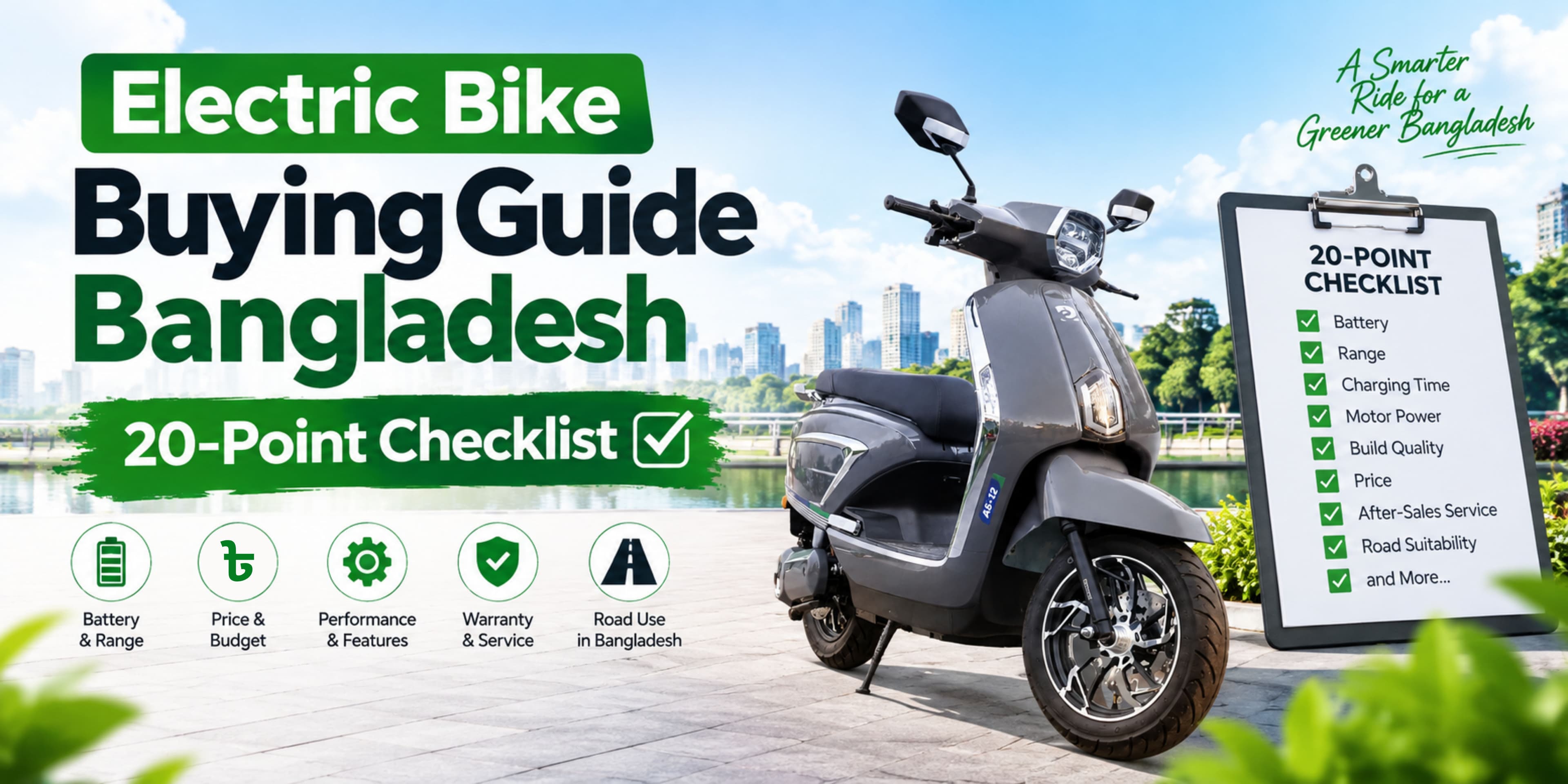
Electric Bike Buying Guide Bangladesh: 20-Point Checklist
Electric Bike Buying Checklist in Bangladesh: 20 Things to Check Before You Buy
Buying an electric bike in Bangladesh should not start with the question, “Which bike looks best?”
Start with a more practical question:
Will this electric bike reliably handle the way I actually ride every day?
A good electric bike should provide enough usable range for your regular route, match your rider and passenger load, charge conveniently where you live, stop and handle confidently, and come with clear battery, warranty, spare-parts and service support.
Before paying for any electric bike or electric scooter, use the following 20-point checklist. It is designed to help Bangladeshi buyers compare vehicles based on what matters after the first week of ownership, not just what looks impressive in the showroom.
Electric Bike Buying Checklist at a Glance
# | What to Check | What You Need to Verify |
|---|---|---|
1 | Daily riding requirement | Your actual km per day |
2 | Total budget | Bike + paperwork + future ownership cost |
3 | Required range | Daily distance plus reserve |
4 | Range claim | Conditions under which range was tested |
5 | Battery | Type, voltage, capacity and configuration |
6 | Battery warranty | Duration, limits and exclusions |
7 | Replacement battery | Price and availability |
8 | Charging time | Realistic 0–100% or stated charging window |
9 | Charging setup | Charger, socket and home-charging requirements |
10 | Motor & performance | Power, acceleration and usable top speed |
11 | Load capacity | Rider + passenger + cargo |
12 | Brakes | Brake type and stopping confidence |
13 | Tyres & clearance | Road grip and ground clearance |
14 | Suspension | Comfort on your normal roads |
15 | Rain protection | Manufacturer's wet-weather guidance |
16 | Test ride | Comfort, balance, controls and handling |
17 | Service support | Where the bike can be serviced |
18 | Spare parts | Availability of important components |
19 | Registration & papers | Exact requirements for the vehicle |
20 | Final delivery inspection | Everything checked before handover |
1. Calculate How Far You Actually Ride Each Day
Do this before looking at specifications.
Calculate your normal round trip:
Home → work/university → errands → home
Suppose your office is 15 km from home. Your basic round trip is already 30 km. If you regularly stop at a market, pick someone up or take a different route because of traffic, your practical daily requirement may be higher.
Do not choose a bike whose advertised maximum range only just covers your daily distance.
Give yourself a reasonable reserve for route changes, heavier loads, higher speeds and other real-world conditions.
Ask yourself:
How many kilometres do I normally travel per day?
Will I regularly carry a passenger?
Will I use the bike for work or delivery?
Do I make unexpected trips during the day?
Can I charge at my destination?
Your answer determines almost everything else you should buy.
2. Set a Total Ownership Budget, Not Just a Purchase Budget
The cheapest electric bike at the showroom is not automatically the cheapest bike to own.
Before comparing prices, consider the complete ownership picture:
Purchase price + registration/paperwork where applicable + electricity + servicing + tyres + brake components + battery replacement risk + other wear items.
The battery deserves particular attention because it is one of the most important and valuable components of an electric vehicle.
A slightly more expensive bike can therefore be the better purchase when it has stronger battery support, easily available parts and reliable servicing.
Before buying, ask for the costs you can verify rather than relying only on statements such as “maintenance is very cheap.”
3. Choose Enough Range for Your Real Commute
Range is one of the first numbers buyers notice, but it is often misunderstood.
If you ride 40 km per day, do not automatically conclude that a bike advertised for 40 or 45 km is suitable.
Range can change according to:
riding speed
rider weight
passenger weight
acceleration
road gradient
tyre pressure
traffic conditions
battery condition
weather
accessories and additional electrical loads
Think of the advertised range as a specification that needs context, not a guaranteed distance you will achieve in every situation.
4. Ask How the Advertised Range Was Measured
This is one of the most useful questions you can ask a salesperson:
“Under what conditions was this range measured?”
For example, ask whether the stated range was achieved with:
one rider or two
Eco mode or a faster riding mode
a particular average speed
flat roads
a fully charged new battery
a specific rider weight
If two bikes both advertise 100 km of range but were tested under very different conditions, the numbers are not directly comparable.
A trustworthy comparison needs context.
5. Understand What Battery You Are Buying
Do not stop after hearing “lithium,” “graphene” or another battery label.
Ask for the actual battery specifications.
At minimum, you should understand:
Battery type
Voltage
Capacity
Whether the battery is removable
Recommended charging method
For lithium batteries, also ask about the battery-management system and the manufacturer's charging and storage guidance.
Battery chemistry alone does not tell you everything about battery quality. Cell quality, battery management, pack construction, charging system, warranty and technical support also matter.
6. Read the Battery Warranty Before Paying
Do not accept:
“Don't worry, the battery has warranty.”
Ask for the written terms.
Find out:
How long is the battery covered?
Is there a kilometre limit?
What faults are covered?
What conditions void coverage?
Is water damage excluded?
Does using a different charger affect coverage?
What happens if battery capacity gradually decreases?
Also distinguish the vehicle warranty from the battery warranty. They may not be identical.
Keep a copy of the warranty terms with your purchase documents.
7. Ask the Replacement-Battery Price Before Buying the Bike
This question is frequently overlooked:
“If I need a replacement battery later, what will it cost and how long will it take to get one?”
You are buying both a vehicle and an energy-storage system.
Ask whether replacement batteries are normally kept in Bangladesh, need to be ordered, can be serviced at module/component level where appropriate, or require full-pack replacement.
You do not necessarily need to buy a replacement now. You simply need to understand your future options.
8. Check the Actual Charging Time
Charging time affects how easily an EV fits into your routine.
Ask for the manufacturer's stated charging time and clarify exactly what that figure means.
For example:
0–100%?
20–80%?
Using which charger?
Under which battery conditions?
A bike that requires overnight charging may work perfectly for someone who travels during the day and parks at home every night.
The same charging pattern may be inconvenient for a commercial rider who needs to operate throughout the day.
Your charging requirements should match your use case.
9. Check Whether You Can Charge Safely at Home
Before purchasing an electric bike, decide where you will charge it.
Ask:
What charger is supplied?
What electrical supply does it require?
Does the manufacturer require an earthed outlet?
Is an extension lead permitted?
Can the battery be removed for indoor charging?
What ventilation is recommended?
Where should the charger be stored?
What should you do if the battery or charger becomes unusually hot?
Always follow the manufacturer's charger and electrical-safety instructions.
Avoid assuming every electric bike uses exactly the same charging procedure.
10. Match Motor Power and Performance to Your Usage
More watts do not automatically mean “better.”
The appropriate motor depends on what you expect the vehicle to do.
A rider making short urban trips has different requirements from someone carrying a passenger, transporting cargo or regularly travelling longer routes.
When comparing motor power, also consider:
vehicle weight
rider load
acceleration
controller setup
top speed
battery system
road conditions
Do not buy purely by the largest motor number available.
Buy enough performance for your actual riding conditions.
11. Verify the Maximum Load Capacity
Think beyond your own body weight.
Calculate:
Rider + passenger + luggage/cargo
If you regularly ride with another person, that total matters.
Commercial users should pay even more attention because tools, products, parcels or delivery boxes add additional weight.
Operating within the manufacturer's specified load limits is important for vehicle performance and safety.
12. Inspect the Braking System
Acceleration gets attention in a showroom.
Braking should get more.
Check what braking system the vehicle uses and, during an authorized test ride, evaluate whether braking feels progressive and controllable.
Look at:
front brake
rear brake
disc/drum configuration
CBS or ABS where fitted
brake lever feel
tyre grip
Do not treat terms such as ABS, CBS or “dual disc” as decoration. Understand what system the specific model actually has.
13. Check Tyres, Wheel Size and Ground Clearance
Bangladeshi road conditions can vary significantly even within the same daily route.
Your commute may include smooth asphalt, speed breakers, broken road surfaces, waterlogged sections or narrow local roads.
Inspect:
Tyre size
Tyre type
Available replacement tyres
Ground clearance
Wheel dimensions
Very low ground clearance may be inconvenient on routes with large speed breakers or rough surfaces.
Tyre availability is also worth checking. An unusual size is less useful if replacement tyres are difficult to source later.
14. Test the Suspension on the Type of Road You Actually Use
You cannot judge suspension by looking at it.
A short showroom test ride on a perfectly smooth surface also tells you very little.
Where the dealer permits it, test the bike over a representative surface and pay attention to:
front suspension response
rear suspension response
stability
rattles
seat comfort
passenger comfort
A bike used for 40 km every day needs to be comfortable for 40 km, not just comfortable for a two-minute showroom ride.
15. Ask Specifically About Rain and Water Exposure
Bangladesh's rainy season makes wet-weather guidance particularly important.
Do not assume “electric” automatically means a bike cannot handle rain, and do not assume every model is fully waterproof either.
Ask the manufacturer or authorized dealer:
What rain exposure is permitted?
Which parts must not be pressure-washed?
Can the bike be parked outside during rain?
What should you do after travelling through water?
Are there specific instructions for the charger and charging port?
Follow the instructions for the exact vehicle.
16. Never Skip the Test Ride
A specification sheet cannot tell you whether a bike fits your body.
During an authorized test ride, check:
Seat height
Handlebar position
Foot position
Turning radius
Low-speed balance
Throttle response
Brake feel
Suspension comfort
Mirror visibility
Dashboard readability
Passenger space
Try low-speed manoeuvring as well as normal acceleration.
For city commuters, easy low-speed control can matter just as much as maximum speed.
17. Find Out Where the Bike Will Be Serviced
Ask this before buying, not after a fault develops.
Find out:
Where is the nearest authorized service point?
What routine servicing is required?
Do technicians receive support for the model?
How are warranty claims handled?
Do you need to transport the vehicle elsewhere for major repairs?
EVEHCO currently maintains a dedicated showroom and dealer-location directory across Bangladesh, allowing buyers to check available locations before visiting.
The right electric bike is not only a vehicle you can purchase. It should also be a vehicle you can realistically maintain.
18. Verify Spare-Parts Availability
Electric vehicles eliminate some petrol-engine maintenance items, but they still contain components that may eventually require servicing or replacement.
Ask about availability for important parts such as:
brake components
tyres
suspension components
lights
throttle/control components
charger
display
electrical components
body panels
battery-related components
You do not need every spare part sitting in the showroom.
You do need a clear answer about how replacement parts are obtained.
19. Verify BRTA Registration and Required Documents
Do not assume that every electric two-wheeler follows exactly the same registration requirement.
The applicable process can depend on how the vehicle is classified and its specifications.
BRTA's current new-vehicle fee calculator specifically includes an Electric Vehicle selection and a kilowatt (kW) field. BRTA's motorcycle-registration information also describes applications through the service portal/showroom and lists documents such as the seller's sale certificate, applicable fee receipt and owner-identification documents among registration requirements.
Before buying, ask the seller:
What is the exact BRTA classification of this model?
Can this exact model be registered?
What papers will I receive?
Who handles the registration process?
What additional fees apply?
If there is uncertainty, verify the current requirement directly through BRTA rather than relying on a general statement about electric bikes.
20. Perform a Final Inspection Before Taking Delivery
The buying process is not finished when you make payment.
Inspect the actual bike being delivered to you.
Check:
Correct model and colour
Battery
Charger
Keys/remotes/NFC cards
Lights
Indicators
Horn
Display
Brakes
Tyres
Body panels
Charging port
Accessories
Owner documentation
Invoice
Warranty documents
Where applicable, record the vehicle identification details and verify that the documents correspond with the vehicle being handed over.
Ask the dealer to demonstrate the basic controls and charging procedure before you leave.
A Simple Showroom Comparison Scorecard
Instead of trying to remember everything, take this table with you and compare two or three shortlisted bikes.
Requirement | |||
|---|---|---|---|
Price | Contact EVEHCO | Contact EVEHCO | Contact EVEHCO |
Battery type | GLA | GLA | GLA |
Battery capacity | 72V / 23A* | 72V / 38A* | 72V / 40A* |
Advertised range | 80–110 km | 100–120 km | 90–100 km, Eco mode |
Range test conditions explained? | Not stated | Not stated | Eco mode stated |
Motor power | 1500W | 1200W | 2000W |
Top speed | 65 km/h | 55+ km/h | 80 km/h |
Maximum load | Not listed | 180 kg | 180 kg |
Brake system | Dual Disc | Dual Disc | Dual Disc + CBS |
Charging time | 4–5 hours | 7–8 hours | 7 hours to 70–80% |
Battery removable? | Not stated | Not stated | Not stated |
Battery warranty | Ask EVEHCO | Ask EVEHCO | Ask EVEHCO |
Vehicle warranty | Ask EVEHCO | Ask EVEHCO | Ask EVEHCO |
Replacement battery available? | Confirm before purchase | Confirm before purchase | Confirm before purchase |
Spare-parts support | Available through EVEHCO support network** | Available through EVEHCO support network** | Available through EVEHCO support network** |
Nearby service | Check nearest EVEHCO location | Check nearest EVEHCO location | Check nearest EVEHCO location |
BRTA paperwork clarified? | Confirm for exact model | Confirm for exact model | Confirm for exact model |
Test ride available? | Available through EVEHCO showroom*** | Available through EVEHCO showroom*** | Available through EVEHCO showroom*** |
Comfortable for you? | Test ride to decide | Test ride to decide | Test ride to decide |
Final decision | Buyer decides | Buyer decides | Buyer decides |
The winning bike does not necessarily need the largest motor or longest advertised range.
It should be the bike that best fits your route, budget, charging situation, load, comfort and support requirements.
Electric Bike Buying Red Flags to Avoid
Be cautious if a buying decision depends entirely on an impressive specification without supporting details.
Examples include an unusually high range claim with no explanation of test conditions, a battery warranty that is only verbal, no clear answer about replacement-battery availability, uncertain spare-parts support, refusal to provide a test ride where one would normally be appropriate, or unclear answers about the vehicle's legal paperwork.
A professional seller should be willing to explain what you are buying.
If an important promise affects your purchase decision, ask for it in writing.
How to Shortlist an Electric Bike in Bangladesh
A practical way to choose is to narrow your options in this order:
Step 1: Determine your daily distance.
This sets your basic range requirement.
Step 2: Determine your load.
Include passengers and cargo.
Step 3: Decide where you will charge.
Home charging, workplace charging or removable-battery charging can change which models are practical.
Step 4: Eliminate models without suitable service and battery support.
A strong specification sheet cannot compensate for poor ownership support.
Step 5: Test ride the remaining models.
Compare comfort, braking, handling and acceleration.
Step 6: Verify paperwork and warranty.
Do this before payment.
Step 7: Compare the complete package.
Only then should price become the final deciding factor.
Before Buying an EVEHCO Electric Bike
If you are considering an EVEHCO model, first compare the current official vehicle lineup and specifications.
Then identify the nearest EVEHCO showroom or authorized dealer and take this checklist with you.
Ask the showroom team to explain the battery, charging procedure, range conditions, motor performance, load capacity, brakes, warranty, service support, spare-parts availability and applicable documentation for the exact model you are considering.
EVEHCO's website currently provides a central product lineup, support section and dealer/showroom directory for buyers researching these details.
A test ride should be used to confirm your decision, not simply to experience fast acceleration.
The objective is to leave knowing exactly what the bike can do, what its limitations are and what support you will receive after purchase.
Frequently Asked Questions
How much range should I look for in an electric bike?
Start with your actual daily round-trip distance and leave additional reserve instead of selecting a vehicle whose maximum advertised range barely covers your commute. Your real range can vary with riding speed, load, road conditions and other factors.
Which electric bike battery is best?
There is no single battery type that is automatically best for every buyer. Compare chemistry, capacity, weight, charging requirements, warranty, replacement cost, battery-management system where applicable and local support.
Can I charge an electric bike at home?
Many electric bikes are designed for home charging, but the required charger and electrical setup depend on the model. Use the approved charger and follow the manufacturer's electrical and charging instructions.
Should I test ride an electric bike before buying?
Yes, when an authorized test ride is available. A test ride allows you to evaluate seat comfort, low-speed balance, throttle response, brakes, suspension, visibility and whether the vehicle suits your body and riding style.
Do electric bikes need BRTA registration in Bangladesh?
Do not apply one answer to every electric two-wheeler. Registration requirements depend on vehicle classification and specifications. BRTA's current new-vehicle fee calculator includes electric vehicles and motor power in kilowatts, so buyers should verify the exact model's applicable process with the seller and BRTA before purchase.
What is the most important thing to check before buying an electric bike?
There is no single specification that determines a good purchase. For most buyers, the most important combination is usable range, battery support, charging convenience, safe performance, after-sales service and suitability for the rider's actual daily use.
Make the Decision Based on Your Daily Life
A good electric bike buying decision is not about selecting the model with the largest number on the specification sheet.
It is about finding a vehicle that works when you leave the showroom.
Know your daily distance. Understand the battery. Check where you will charge. Verify the warranty. Confirm replacement support. Test the brakes and comfort. Ask about service and spare parts. Clarify the paperwork. Then compare prices.
Do those 20 checks before paying, and you will be in a much better position to choose an electric bike that fits your daily life in Bangladesh.
Ready to compare your options? Explore the current EVEHCO electric vehicle lineup, then visit your nearest EVEHCO showroom or authorized dealer for a test ride and model-specific guidance.