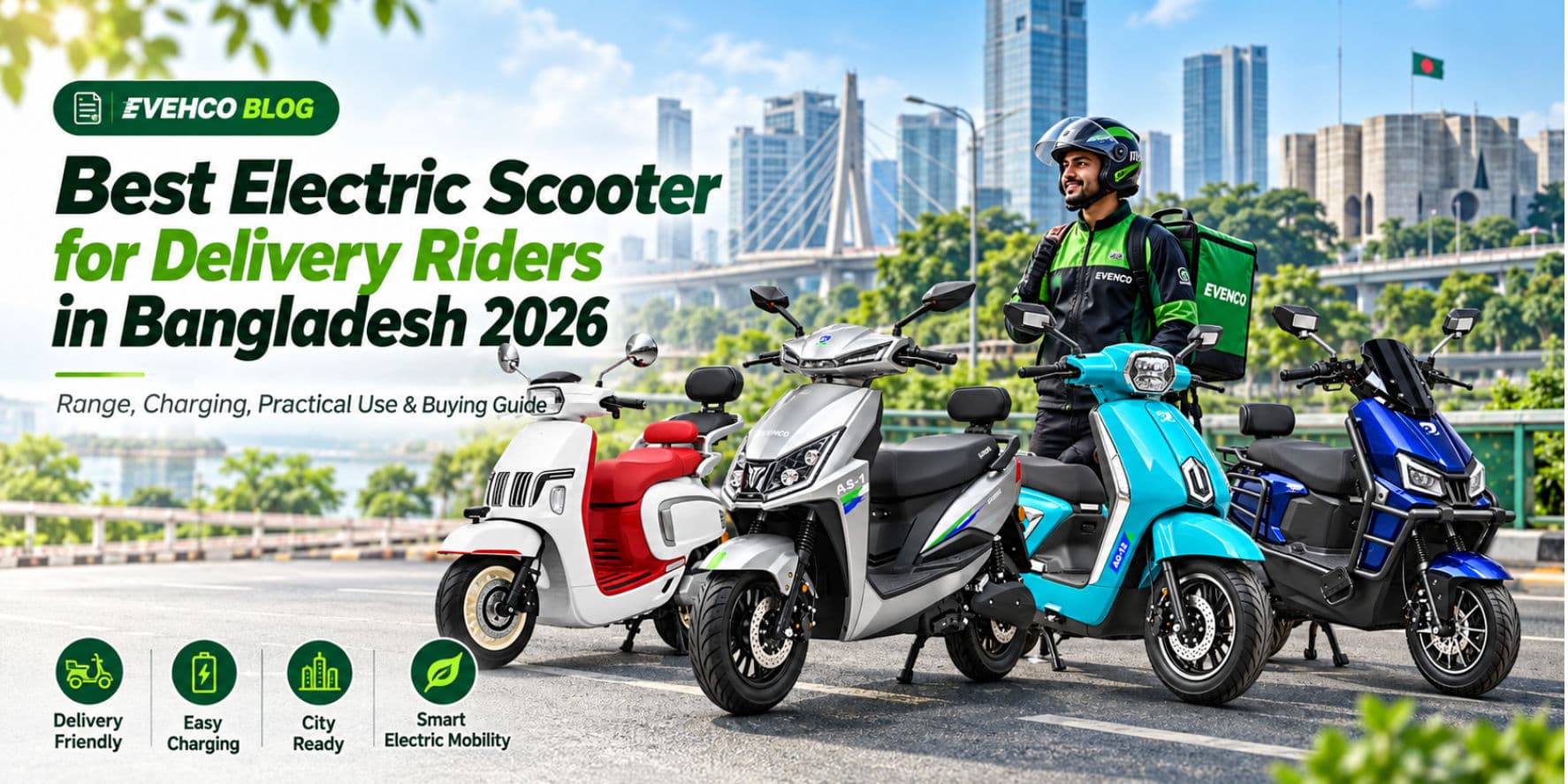
Best Electric Scooter for Delivery Riders in Bangladesh 2026
Quick Answer: Which Electric Scooter Suits Delivery Work?
The best electric scooter for delivery riders in Bangladesh is not necessarily the fastest model or the one with the largest advertised range. It is the scooter that can complete a normal delivery shift with a sensible battery reserve, carry equipment securely, recharge within the rider's schedule and receive dependable servicing.
For urban deliveries, compare the EVEHCO AS-1, AS-12, AS-12 New and AS-15. The CH-25 has heavy-duty specifications, but EVEHCO currently labels it Coming Soon. This guide compares official specifications and demonstrates running-cost calculations without claiming unverified prices or savings.
This 2026 guide explains the practical requirements of food and parcel delivery, compares published EVEHCO specifications and shows how to calculate electricity costs without relying on unverified selling prices or savings claims.
Why Delivery Riders Consider Electric Scooters in Bangladesh
Food and parcel deliveries involve repeated stops and short routes. Electric scooters use electricity instead of petrol for propulsion and avoid some engine-related maintenance. Yet tyres, brakes, batteries and electrical systems still require care. Charging access, cargo needs and a reliable service network are essential.
Choose for your actual working day. A 25 km shift differs from a loaded 90 km shift. Weather, road surfaces and service downtime can matter as much as published range. Compare full ownership costs, not just charging bills.
Six Things Delivery Riders Should Check Before Buying
1. Measure Working Distance, Not Just Home-to-Office Distance
Track several typical shifts, including travel to pickups, between customers and back home. Record the busiest day. Advertised range is not guaranteed with commercial loads: traffic, acceleration, road gradients, weather, battery age and riding mode change results.
Plan a practical reserve instead of using a manufacturer's maximum range as your full daily allowance. If you routinely need more kilometres than a scooter can comfortably deliver in your conditions, adjust charging arrangements or shortlist another option.
2. Check the Total Load and Cargo Setup
Payload includes the rider, protective equipment, delivery box and cargo. EVEHCO lists 180 kg capacity for AS-1, AS-12 and AS-15, and 220 kg for CH-25. These figures do not establish that every box or mounting arrangement is safe.
Ask the showroom about approved luggage mounting, stability, weight distribution and whether modifications affect the warranty. Never exceed the stated limit, cover lights or number plates, or carry unsecured deliveries. For the AS-12 New, confirm the applicable payload limit directly because its current online specifications do not state one.
3. Fit Charging Around the Shift
Confirm safe charging access and the listed charging time for the exact model. EVEHCO quotes 5–6 hours for AS-12 New and 7–8 hours for standard AS-12, but actual timing depends on charging conditions. Work shifts must leave adequate time.
Only use the manufacturer-approved charger and a suitable electrical connection. Follow the supplied instructions for supervision, ventilation, rain and charging temperature. Never rely on an improvised extension cord or charge a damaged battery.
4. Test Low-Speed Handling and Braking
Delivery work involves frequent starting, parking and manoeuvring, so assess turning radius, braking control, balance with your normal equipment, seat comfort and suspension. Test in a safe, authorised setting at legal speeds. A high motor-power number does not automatically make a scooter more productive in congested traffic.
5. Confirm Service and Battery Support
Ask who performs warranty repairs, what the battery warranty actually covers, which consumable parts are stocked and how long typical servicing takes. Keep records of routine checks. A vehicle that spends several working days awaiting parts can disrupt earnings even if its electricity bill is low.
6. Confirm Legal Road Use and Insurance
Before starting commercial delivery activity, verify the vehicle's applicable BRTA registration, driving-licence, insurance and road-use requirements, as well as any commercial-use restrictions. Delivery-platform rules may introduce additional conditions. Wear an appropriate helmet, follow traffic laws and keep deliveries secured.
EVEHCO Electric Scooters for Delivery Riders: Model Comparison
The figures below come from EVEHCO's product listings reviewed in October 2026. They are manufacturer-published specifications, not independent commercial-route tests. Stock, variants and written warranty conditions must be checked with EVEHCO before purchase.
EVEHCO model | Motor | Advertised range | Listed charging time | Listed load capacity | Delivery-use consideration |
|---|---|---|---|---|---|
1000W | 90–100 km, ECO mode | 6–8 hours | 180 kg | Shorter urban shifts and lighter delivery routines | |
1200W | 100–120 km | 7–8 hours | 180 kg | Regular city routes with NFC convenience | |
1500W | 100–140 km | 5–6 hours | Not listed online | Riders prioritising a shorter published charge window | |
2000W | 100–140 km | 6–7 hours | 180 kg | Those seeking more motor power and CBS-equipped braking | |
3000W | 100–140 km | 2.5–3.5 hours | 220 kg | Heavy-duty candidate; Coming Soon on the online lineup |
AS-1 and AS-12: Evaluate for Routine Urban Deliveries
The AS-1 lists a 1000W motor, dual-disc brakes and 90–100 km ECO-mode range. The AS-12 lists 1200W, dual-disc brakes, NFC access and 100–120 km range. Validate both on representative routes instead of relying on advertised range under loaded conditions.
AS-12 New and AS-15: Compare Charging and Control
The AS-12 New lists 1500W and 5–6 hour charging but does not publish payload capacity online. The AS-15 lists 2000W, dual-disc brakes with CBS and 6–7 hour charging. Test braking, comfort and usable range. Request confirmation of the AS-15 variant because some website descriptions differ.
CH-25: A Heavy-Duty Option to Ask About
The CH-25 product listing gives a 3000W motor, 220 kg load capacity, portable battery, dual-channel ABS and a 2.5–3.5 hour published charging time. These features make it relevant to discussions about heavier commercial requirements, but its online lineup says Coming Soon. Do not schedule deliveries around it until the showroom confirms availability, road-use eligibility, permissible cargo configuration and delivery timing.
How Much Electricity Could a Delivery Scooter Use?
A trustworthy calculation starts with electricity drawn from the wall, not only the battery's nominal size. A plug-in meter suitable for the charger can help measure the energy used for a normal series of charges. Charging losses, temperature and riding conditions affect the figure.
Use these formulas:
Monthly distance (km) = average kilometres per working day × working days.
Monthly charging energy (kWh) = monthly distance × measured wall-energy use (kWh/km).
Monthly charging cost (BDT) = monthly charging energy × applicable electricity rate (BDT/kWh).
Illustrative Cost Calculation for 60 km and 90 km Shifts
The following is math-only planning, not EVEHCO test data or a statement of Bangladesh's current electricity tariff. Assume 26 working days, hypothetical wall-energy use of 0.04 kWh/km, and a hypothetical electricity rate of ৳10/kWh. Replace both assumptions with your own measurements and billed rate before making a buying decision.
Example shift | Days/month | Monthly distance | Assumed wall energy | Illustrative charging cost |
|---|---|---|---|---|
60 km/day | 26 | 1,560 km | 62.4 kWh | ৳624/month |
90 km/day | 26 | 2,340 km | 93.6 kWh | ৳936/month |
For example, 1,560 × 0.04 = 62.4 kWh, followed by 62.4 × ৳10 = ৳624. This is not a claim that any EVEHCO model will achieve 0.04 kWh/km. The second example uses the same hypothetical inputs. Real bills may include additional charges or a different tariff structure.
Comparing with a Petrol Delivery Bike
For a fair comparison, estimate petrol cost = monthly kilometres ÷ measured fuel economy (km/litre) × actual pump price per litre. Compare that result with metered electricity expenses over similar routes and loads. Then include tyres, brakes, maintenance, insurance, financing if applicable, battery replacement allowance and lost working time. Avoid judging return on investment from energy cost alone.
For a wider discussion of ownership expenses, read Electric Scooter vs Petrol Bike in Bangladesh.
Which Delivery Schedule Matches Your Scooter?
Short local routes: For a rider delivering meals within a smaller zone, prioritise manoeuvrability, safe cargo mounting, comfort and reliable charging. Start by test-riding the AS-1 and AS-12, assuming their availability is confirmed.
Longer mixed-city shifts: Compare AS-12, AS-12 New and AS-15 after measuring busy-day distance and charging access. An advertised 100–140 km range does not guarantee 100 km during demanding deliveries.
Bulkier or heavier assignments: Evaluate total payload and approved carrying systems first. The CH-25 has a higher listed load rating but is currently marked Coming Soon. Never substitute motor power for confirmation of safe cargo capacity.
If you operate several vehicles, record charging energy, number of stops, route distance, maintenance events and days unavailable for each unit. A small, consistent pilot trial is more informative than forecasting savings from advertising alone.
Daily Maintenance and Riding Checklist for Couriers
Before each shift, check tyre condition and pressure, brake response, lighting, horn, mirrors, secure cargo mounts and battery charge. Confirm that the delivery box cannot swing, block visibility or interfere with controls. Keep the charger and connectors dry and inspect them for damage.
Accelerate smoothly, obey road rules and stop if brakes or electrical equipment behave abnormally. Follow the manufacturer’s wet-weather instructions and never assume a scooter tolerates floodwater. Charge as instructed after each shift.
Delivery riders also need a sensible work schedule. Fatigue, rushing and phone use while moving increase risk. Pull over safely before checking new orders or navigation instructions.
Where to Compare EVEHCO Models in Bangladesh
For a practical comparison, browse the EVEHCO lineup, find an outlet using the showroom directory, and ask for a test ride with representative delivery equipment. Check the support page for service and warranty questions.
See our office commuting guide for non-delivery use and electric scooter price guide for buying considerations. Confirm current prices, stock and commercial-use warranty terms directly.
Frequently Asked Questions
Is an electric scooter suitable for food delivery in Bangladesh?
It can be suitable when its tested usable range, charging access, payload rating and after-sales support match your route. Frequent stops or cargo weight may reduce achievable distance, so validate the setup before depending on it for paid shifts.
How far can an EVEHCO scooter travel on one charge?
Published range varies by model, from 90–100 km in ECO mode for AS-1 to 100–140 km for several higher-spec models. These are advertised figures, not guarantees for delivery routes. Always allow a reserve and confirm the exact model variant.
Which EVEHCO scooter has the highest listed payload?
Among the models compared here, the CH-25 has a published 220 kg load capacity; the AS-1, AS-12 and AS-15 list 180 kg. The AS-12 New page does not specify a load capacity. The CH-25 is marked Coming Soon in the online lineup.
What will charging cost for 60 km of deliveries per day?
That depends on measured wall-energy use, your electricity tariff and the number of working days. In the illustrative example above, 60 km/day for 26 days at assumed 0.04 kWh/km and ৳10/kWh produces ৳624 in charging energy cost. It is not an EVEHCO performance claim or a verified current tariff.
Can I attach a large delivery box to an electric scooter?
Ask EVEHCO whether the proposed mounting kit and box size are approved for your model. Keep total payload within the stated limit and ensure the box does not obstruct lighting, registration plates, steering or safe balance.
Can delivery riders use an electric scooter on public roads?
That depends on the vehicle classification, registration and licensing rules and your intended road. Confirm current BRTA requirements and applicable delivery-platform policies. Do not assume every electric two-wheeler has identical legal status.
Final Recommendation: Choose for Your Real Delivery Shift
Start with your busiest shift, realistic range reserve, charging access and cargo weight. Compare specifications, then test handling and braking with representative loads. Judge total ownership cost, not only electricity use or motor power.
Ready to explore an EVEHCO scooter for delivery work? Compare models, locate a showroom, or contact EVEHCO support to confirm an appropriate model, current stock, written warranty, available accessories and test-ride arrangements.